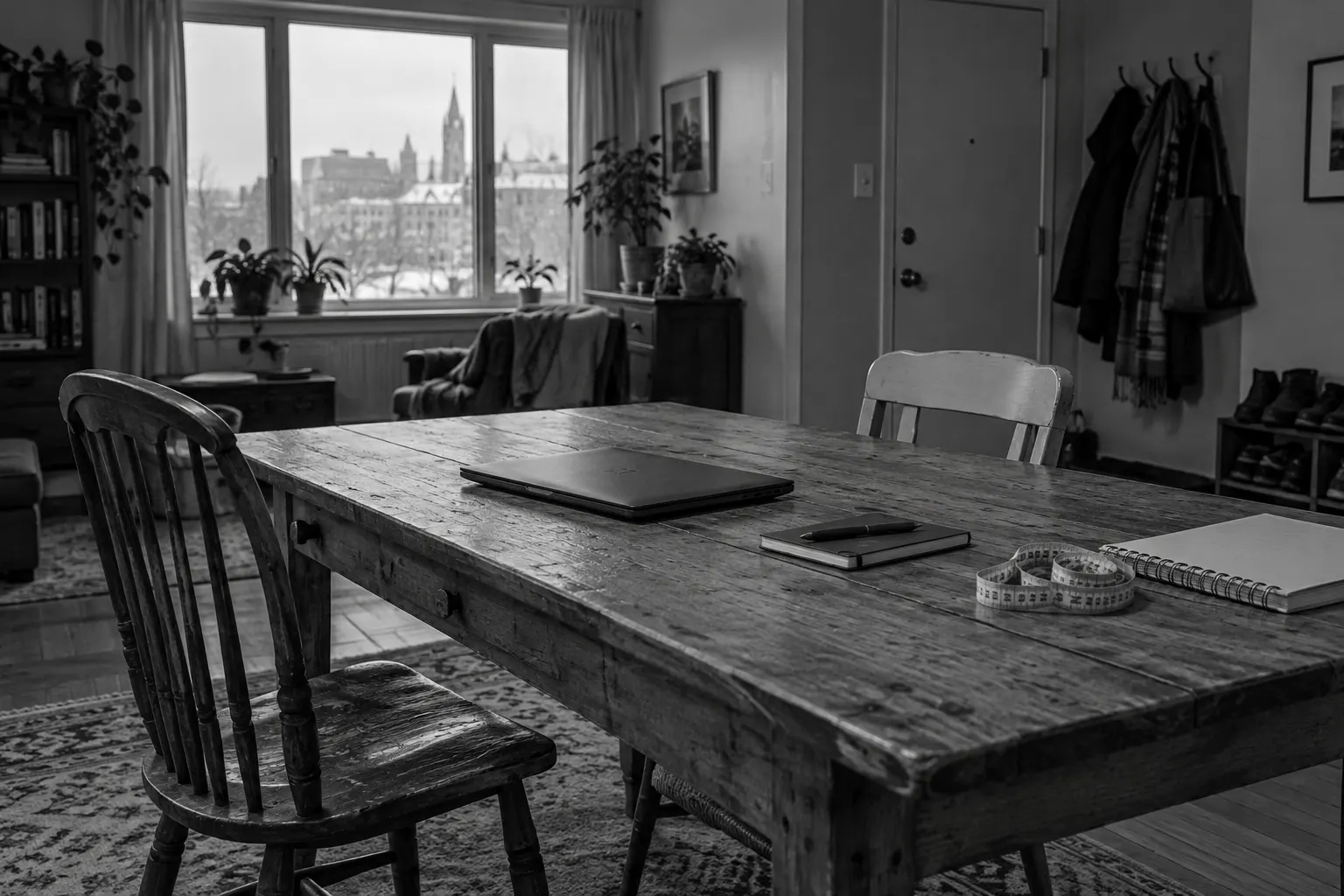
I had six dining chairs lined up by the door and no place to put my boots. The customer was arriving at four. At three fifty, Étienne walked in carrying groceries and asked whether we were opening a restaurant.
"They're leaving," I said.
"You said that about the green armchair."
The green armchair was waiting for fabric. It had been waiting for fabric since August.
I'm Camille. I repair and reupholster furniture from our Ottawa apartment, with more confidence around a staple gun than a spreadsheet. That September order was my largest yet. After the chairs left, I sat down to admire the invoice. Then I opened the sales tab I had been avoiding.
The number I had been watching was the wrong one
I had been looking at what remained after fabric, foam and delivery costs. Useful for deciding whether I could buy groceries. Wrong for checking the small-supplier threshold.
For most businesses, the $30,000 GST/HST test uses worldwide taxable revenue before expenses, including zero-rated supplies and associated businesses. Certain proceeds, including capital-property sales, are excluded. It is not a profit allowance. CRA registration rules.
I made four rows in my notebook:
- October to December 2025: $8,400.
- January to March 2026: $7,600.
- April to June 2026: $6,800.
- July to September 2026: $9,200.
Total: $32,000. In this example, those are all my counted taxable sales, with no associated businesses. No single quarter exceeded $30,000. The four-quarter total did.
Étienne looked over my shoulder. "So the chairs were good news?"
"Yes. The spreadsheet just wants a word."
Two timelines that are easy to mix up
Across quarters: when the total exceeds $30,000 over four or fewer consecutive calendar quarters, but not in one quarter, small-supplier status ends after the following month. My September quarter therefore points to October 31. If my first supply after that is November 2, registration must take effect no later than that supply, and I charge tax from that effective date. Registration is due within 29 days of that date.
Inside one quarter: suppose instead I already had $29,500 of counted sales that quarter and made a $1,200 sale. That sale crosses the threshold. Tax applies to the whole $1,200 supply, starting then, with registration required within 29 days. CRA's small-supplier examples.
For an ordinary taxable furniture repair supplied in Ontario, 13% HST on $1,200 is $156. The invoice total would be $1,356 if the agreed price is before tax. Different supply locations or exemptions need their own check; my Ottawa example is not a rate rule for every customer.
What I put beside the next invoice
I did not redesign my entire bookkeeping system that evening. I added a quarterly-sales sheet, a running four-quarter total, and a note to check the registration date before the next supply.
My folder now has:
- The dated sales list, including work from any other business I run.
- A separate list of expenses, so they don't quietly reduce the sales test.
- The customer agreement showing whether the price includes tax.
- The registration details and the invoice template to update when registration takes effect.
Taxi and commercial ride-sharing businesses have special registration rules even below the threshold. Voluntary registration is also possible for eligible small suppliers. Those are different decisions from the two threshold examples above.
The next morning, I could find my boots. I could also explain why a good month meant checking more than the bank balance.
The green armchair was still there. Apparently it was now part of the office, which led to my next argument with the dining table.
Sources for the numbers
Canadian GST/HST rules checked October 20, 2026; examples concern an Ontario sole proprietor. See CRA registration timing and CRA's registrant guide, including provincial rates.