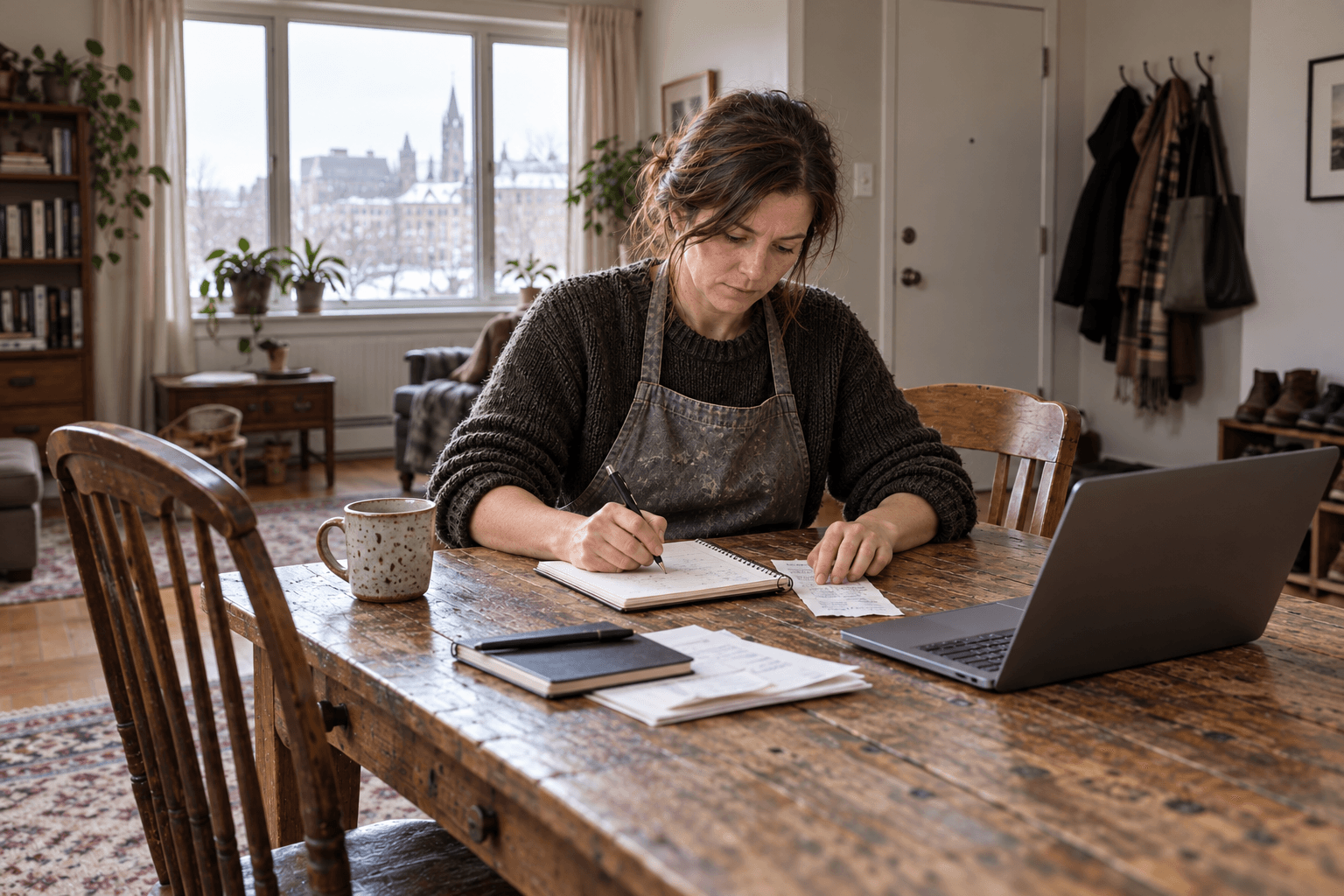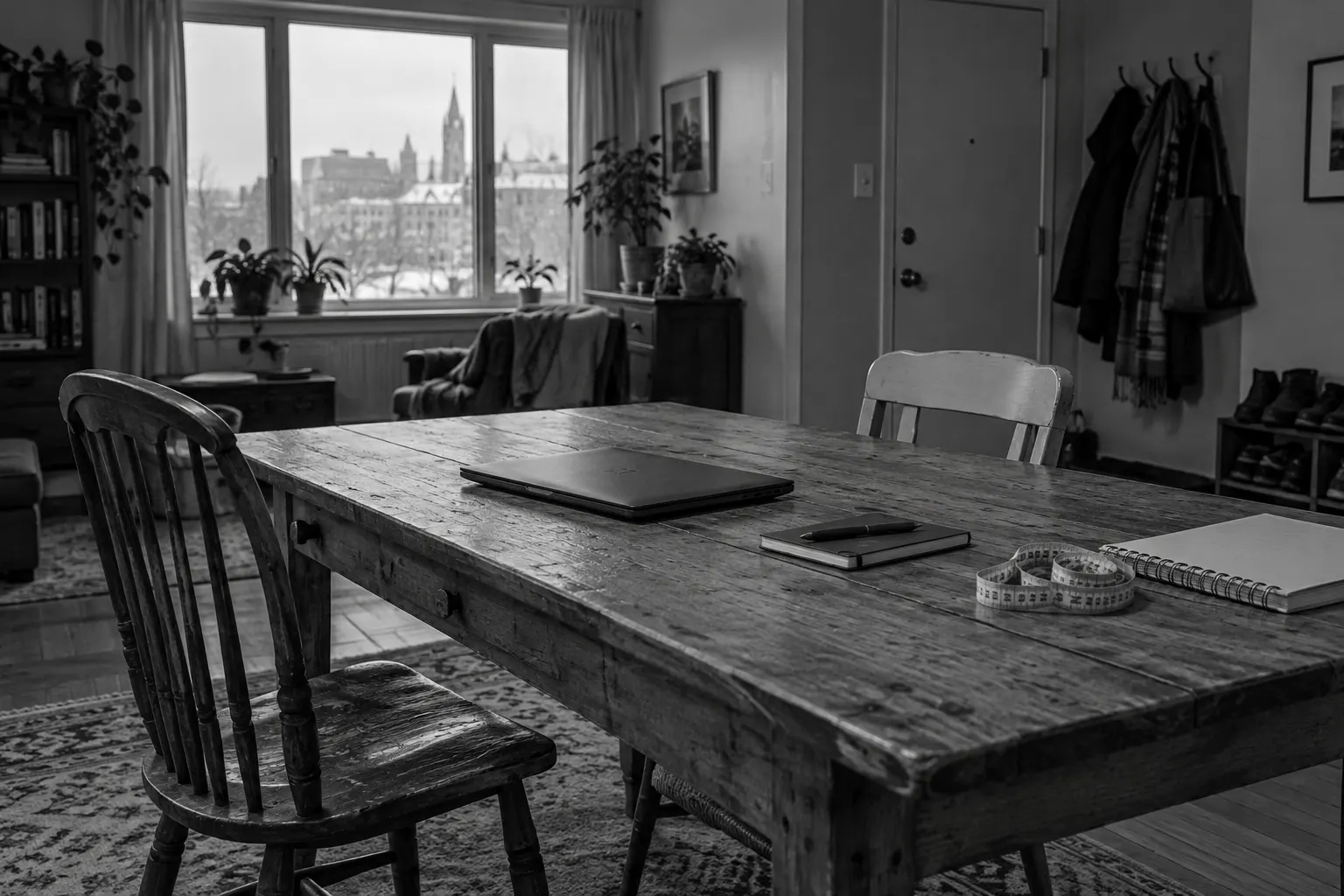
I measured the dining room while Étienne made toast. This was already an improvement on my first method, which had been to look at the table and think, "Quite a lot of work happens there."
The tape caught on a chair leg. My niece's maths book was open beside the laptop. She does her homework here on Tuesdays while her mother works late. I moved it to make room for my notebook, then moved it back. It belonged in the evidence.
After sorting out my HST sales totals, I had become dangerously enthusiastic about percentages.
First, does the workspace qualify?
I do my upholstery work in the back room of our Ottawa home and my quotes, ordering and accounts at the dining table. Home is my main place of business. That matters before any measuring begins.
For self-employed business-use-of-home expenses, CRA requires either that the workspace be your main business location, or that it be used exclusively to earn business income and regularly to meet clients, customers or patients. A shared room can qualify through the first condition; putting a laptop anywhere does not settle it. CRA's home-business guidance.
"So you're measuring the whole room?" Étienne asked.
"I'm measuring the part I can explain."
That sounded responsible. I had only just thought of it.
The missing part of my calculation was dinner
For this simplified example, my shared workspace is 100 square feet in a 1,000-square-foot home. I use it for business eight hours a day, five days a week, throughout the year. The room is used personally at other times.
The space fraction is 100 ÷ 1,000 = 10%. A time adjustment gives:
10% × 8/24 × 5/7 = approximately 2.38%.
With $24,000 in eligible annual household costs used for this example, the allocation is about $571.43, before the business-income limit. I keep the fractions unrounded until the final calculation. Using 10% alone would have produced $2,400.
The $24,000 is my expense pool, not a standard allowance. It excludes any separate workshop allocation. No expense gets counted twice.
CRA asks for a reasonable space allocation and an adjustment for personal use and partial-week or partial-year business use. The detailed home-expense folio also explains eligible rent and household costs. These expenses cannot create or increase a business loss; amounts restricted by that limit may carry forward under the applicable rules.
This is the self-employed calculation. An employee working from home has different eligibility and documentation rules.
A folder I can understand next spring
I sketched the room, wrote down the measurements, and dated the page. Then I saved my rent records and household bills beside it. For the shared table, I kept a realistic work schedule, including weeks away, instead of pretending every day looked like my busiest Tuesday.
My note for next spring has four questions:
- Was this still my main business location?
- Did the area or its personal use change?
- Which costs actually belong in this calculation?
- Is there enough business income to deduct the allocated amount this year?
The answer won't be "10% because that was last year's number."
Étienne put down two plates. I closed the laptop, moved the measuring tape and put the maths book somewhere safe. The table was changing shifts.
For the rest of the return, I still needed my self-employed tax checklist. One tidy folder was a start.
Sources for the calculation
Canadian self-employed income-tax rules checked October 20, 2026. This Ontario example assumes the stated workspace and schedule apply throughout 2026. Sources: CRA: running a business from home and Income Tax Folio S4-F2-C2.