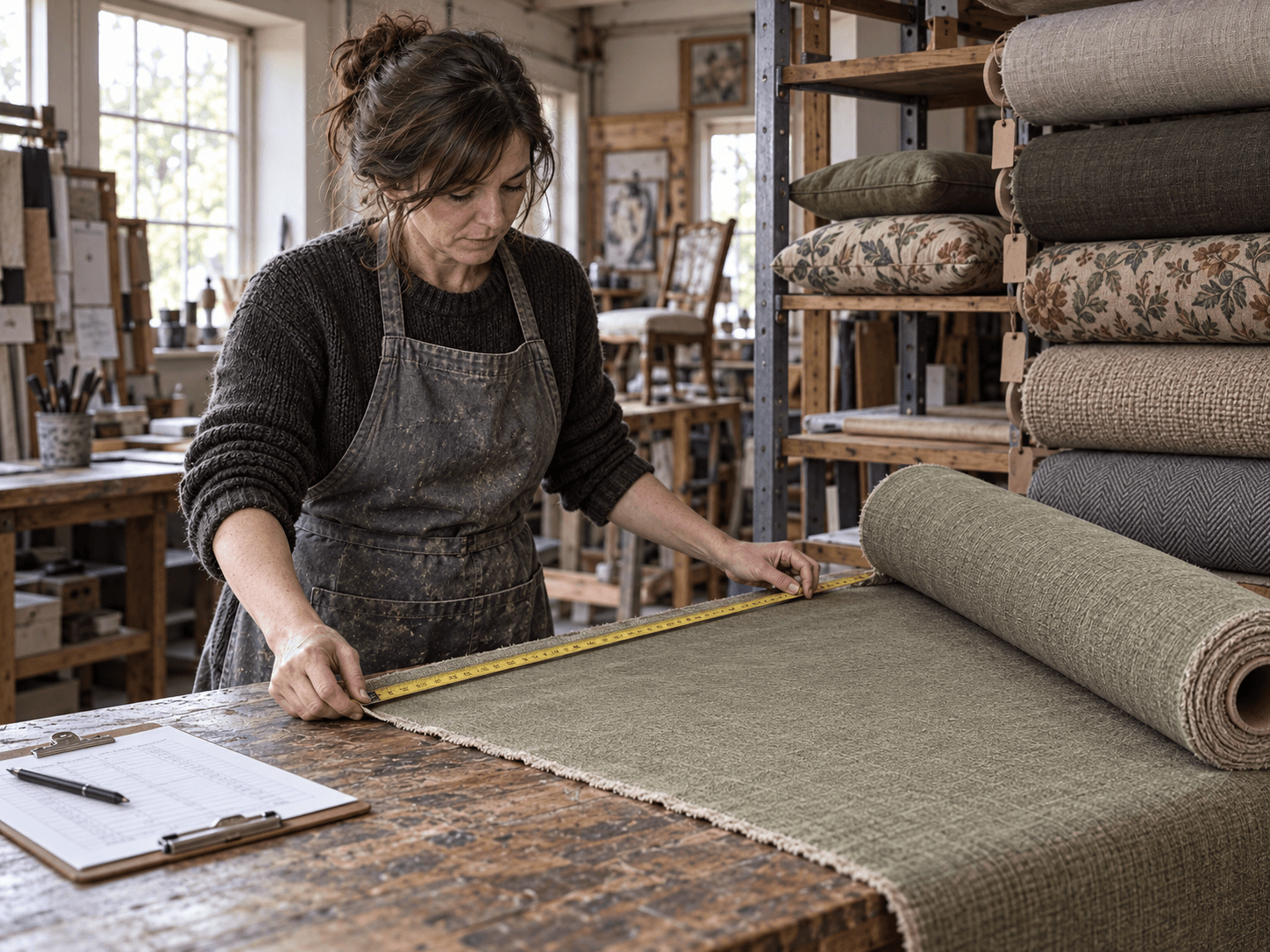
I wanted to finish the December bookkeeping before supper. Then I opened the workshop cupboard and found six rolls of fabric I had forgotten about.
The invoices were already entered. Surely that meant I was done with them. But some fabric had become cushions I had sold, some was still on the rolls, and two finished cushions were waiting for their buyer.
Count what is still there
For an ordinary business buying or making goods for resale, the inventory calculation connects purchases to goods sold. Raw materials, work in progress and finished goods can all belong in that count. The tools I use repeatedly are a different category.
I made a sheet with the item, quantity, unit cost, condition and supporting invoice. I marked the two finished cushions separately so I wouldn't count their fabric again. Damaged stock got a note instead of an arbitrary number.
CRA describes accepted valuation methods and expects consistent use. An actual period-end count is generally required unless a perpetual inventory system with periodic counts is used. CRA's inventory and cost-of-sales guidance.
For an ordinary resale business, the two methods are the fair market value of the entire inventory, or the lower of cost and fair market value for each item (or indistinguishable group). For example, a roll costing $100 with a supported year-end fair market value of $70 would be valued at $70 under the second method. Keep the valuation evidence and continue the established method; do not switch methods simply to obtain a preferred result that year. CRA's valuation rules.
Follow the calculation
In a simplified example, opening inventory of $1,000, purchases of $5,000 and closing inventory of $1,500 give $4,500 in cost of goods sold. This leaves out sales taxes, labour and other adjustments to make the inventory movement clear.
The extra $500 on the shelf hasn't disappeared from my records. It remains in closing inventory and carries into the next period's opening figure. Buying more fabric in December doesn't automatically turn every dollar into that year's cost of sales.
I finished the count after supper. The shelf was no tidier, but the list finally described the things actually sitting on it.
Ordinary resale-business example, checked October 20, 2026. Specialized inventory rules, including some artists' elections, need separate review. See equipment versus supplies.